141. Linked List Cycle
| Attempt | Time Required |
|---|---|
| For notes | 13 min 55 sec |
Question
Given head, the head of a linked list, determine if the linked list has a cycle in it.
There is a cycle in a linked list if there is some node in the list that can be reached again by continuously following the next pointer. Internally, pos is used to denote the index of the node that tail's next pointer is connected to. Note that pos is not passed as a parameter.
Return true if there is a cycle in the linked list. Otherwise, return false.
Example 1:
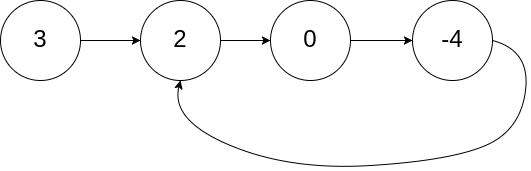
Input: head = [3,2,0,-4], pos = 1
Output: true
Explanation: There is a cycle in the linked list, where the tail connects to the 1st node (0-indexed).
Example 2:
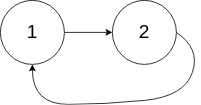
Input: head = [1,2], pos = 0
Output: true
Explanation: There is a cycle in the linked list, where the tail connects to the 0th node.
Example 3:

Input: head = [1], pos = -1
Output: false
Explanation: There is no cycle in the linked list.
Constraints:
- The number of the nodes in the list is in the range
[0, 104]. -105 <= Node.val <= 105posis-1or a valid index in the linked-list.
Follow up: Can you solve it using O(1) (i.e. constant) memory?
Approach 1: Brute Force
Intuition
- Using a map data structure.
Algorithm
- Declare an
unordered_map<ListNode*, int> m. - Declare & initialize
ListNode* curr = head. - Loop through the LL till
curr != NULL.- If
currexists in the mapmthen returntrue - Else add the
currnode to the mapm curr = curr->nextfor looping
- If
- Return false
Code
class Solution {
public:
    bool hasCycle(ListNode *head) {
        unordered_map<ListNode*, int> m; // O(n)

        ListNode* curr = head;

        while (curr) { // O(N)
            if (m.find(curr) != m.end()) { // O(log(N))
                return true;
            }
            m[curr]++; // O(log(N))
            curr = curr->next;
        }
        return false;
    }
};
Complexity Analysis
- Time Complexity:
- Space Complexity:
Approach 2: Optimal
Intuition
- Floyd's Tortoise Hare Cycle Finding Algorithm
- Fast & Slow pointer
Algorithm
- Declare & initialize
ListNode* fast&ListNode* slowtohead. - Loop through the LL while
fast != NULLandfast->next != NULL, as we are going to usefast->next->next.fastwill increment with 2 nodes per iterationfast = fast->next->next.slowwill increment with 1 node per iterationslow = slow->next.- If
fast == slowthen return true.
- Return false
Code
class Solution {
public:
    bool hasCycle(ListNode *head) {
        ListNode* fast = head;
        ListNode* slow = head;

        while (fast && fast->next) {
            fast = fast->next->next;
            slow = slow->next;
            if (fast == slow) {
                return true;
            }
        }

        return false;
    }
};
Complexity Analysis
- Time Complexity:
- Space Complexity: