547. Number of Provinces
Question
There are n cities. Some of them are connected, while some are not. If city a is connected directly with city b, and city b is connected directly with city c, then city a is connected indirectly with city c.
A province is a group of directly or indirectly connected cities and no other cities outside of the group.
You are given an n x n matrix isConnected where isConnected[i][j] = 1 if the ith city and the jth city are directly connected, and isConnected[i][j] = 0 otherwise.
Return the total number of provinces.
Example 1:
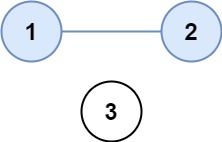
Input: isConnected = [[1,1,0],[1,1,0],[0,0,1|1,1,0],[1,1,0],[0,0,1]]
Output: 2
Example 2:
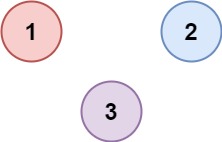
Input: isConnected = [[1,0,0],[0,1,0],[0,0,1|1,0,0],[0,1,0],[0,0,1]]
Output: 3
Constraints:
1 <= n <= 200n == isConnected.lengthn == isConnected[i].lengthisConnected[i][j]is1or0.isConnected[i][i] == 1isConnected[i][j] == isConnected[j][i]
Approach 1: Optimal Solution
Intuition
- Connected components
Algorithm
- Create adjacency list from adjacency matrix
- Maintain count of connected components
noOfProvinces - Create a
visitedarray - Loop through the visited array and
- if a node is not visited then do a traversal through the graph from that point by either
dfsorbfs - Increment
noOfProvinces
- if a node is not visited then do a traversal through the graph from that point by either
- Return
noOfProvinces
Code
class Solution {
private:
    void dfs(int node, vector<vector<int>>& adj, vector<int>& visited) {
        if (visited[node]) return;
        visited[node] = 1;
        for (auto neighbor: adj[node]) {
            dfs(neighbor, adj, visited);
        }
    }

    void bfs(int node, vector<vector<int>>& adj, vector<bool>& visited) {
        if (visited[node]) return;

        queue<int> q;
        visited[node] = true;
        q.push(node);

        while (!q.empty()) {
            int currNode = q.front();
            q.pop();

            for (auto neighbor: adj[currNode]) {
                if (!visited[neighbor]) {
                    visited[neighbor] = true;
                    q.push(neighbor);
                }
            }
        }
    }


public:
    int findCircleNum(vector<vector<int>>& isConnected) {
        int n = isConnected.size();
        vector<vector<int>> adj(n, vector<int>());
        for (int i = 0 ; i < n ; i++) {
            for (int j = 0 ; j < n ; j++) {
                if (i != j && isConnected[i][j]) {
                adj[i].push_back(j);
                adj[j].push_back(i);
                }
            }
        }

        int noOfProvinces = 0;
        vector<int> visited (n, 0);

        for (int i = 0 ; i < n ; i++) {
            if (!visited[i]) {
               noOfProvinces++;
               dfs(i, adj, visited);
               // bfs(i, adj, visited);
            }
        }

        return noOfProvinces;
    }
};
Complexity Analysis
- Time Complexity:
- Space Complexity:
- N -> no. of nodes
- E -> no. of edges