559. Maximum Depth of N-ary Tree
Question
Given a n-ary tree, find its maximum depth.
The maximum depth is the number of nodes along the longest path from the root node down to the farthest leaf node.
Nary-Tree input serialization is represented in their level order traversal, each group of children is separated by the null value (See examples).
Example 1:
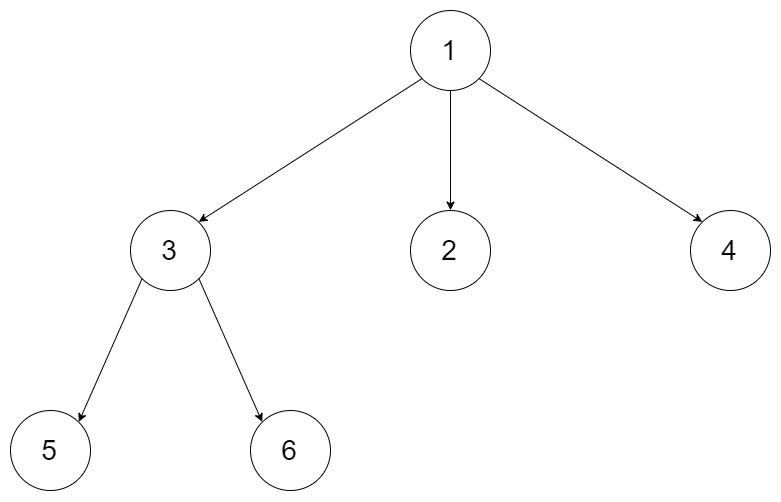
Input: root = [1,null,3,2,4,null,5,6]
Output: 3
Example 2:
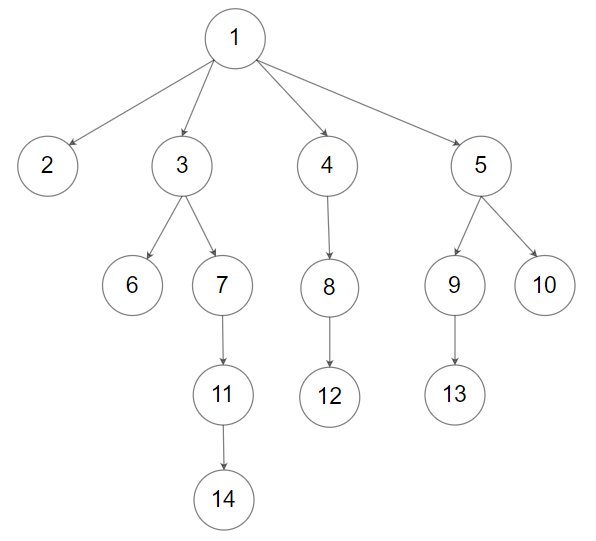
Input: root = [1,null,2,3,4,5,null,null,6,7,null,8,null,9,10,null,null,11,null,12,null,13,null,null,14]
Output: 5
Constraints:
- The total number of nodes is in the range
[0, 104]. - The depth of the n-ary tree is less than or equal to
1000.
Approach 1: BFS
Intuition
- Tracking depth in BFS is easier and straight forward.
Algorithm
- Declare and initialize a
depthvariable with1to track the max depth. (1 as if root exists the depth is at least 1) - Declare a
queue<pair<Node*, int>>to track the depth for each node. - Push the root and depth into the queue
- Loop till queue is not empty
- Get the current node and current depth from the front of the queue
- Pop the queue
- Update the max depth by comparing with the current depth
- Loop over the neighbors (children) of the current node
- Push them into the queue with currDepth + 1
- Return depth.
Code
/*
// Definition for a Node.
class Node {
public:
    int val;
    vector<Node*> children;
};
*/

class Solution {
public:
    int maxDepth(Node* root) {
        if (root == NULL) return 0;

        int depth = 1;
        // node, depth
        queue<pair<Node*, int>> q;
        q.push({root, 1});

        while (!q.empty()) {
            Node* node = q.front().first;
            int currDepth = q.front().second;
            q.pop();

            depth = max(currDepth, depth);

            for (auto neighbor: node->children) {
                q.push({neighbor, currDepth + 1});
            }
        }

        return depth;
    }
};
Complexity Analysis
- Time Complexity:
- Space Complexity:
Approach 2: DFS
Intuition
- Traversal option
Algorithm
- Declare a function
getMaxDepththat takes a node and currDepth as argument and returns an int (which is the max depth); - We can skip the base case because the tree is going to finish as some point.
- In the processing & recurse case step we are calling the same function for the children of the node.
- Calculating the maxDepth by getting the max of the function output of the child and the currentDepth
- Return the maxDepth
Code
/*
// Definition for a Node.
class Node {
public:
    int val;
    vector<Node*> children;
};
*/

class Solution {
public:
    int getMaxDepth(Node* node, int currDepth) {
        int maxDepth = currDepth;
        for (Node* child : node->children) {
            maxDepth = max(best, getMaxDepth(child, currDepth + 1));
        }
        return maxDepth;
    }

    int maxDepth(Node* root) {
        if (root == NULL) return 0;

        return getMaxDepth(root, 1);
    }
};
Complexity Analysis
- Time Complexity:
- Space Complexity: