785. Is Graph Bipartite?
Question
There is an undirected graph with n nodes, where each node is numbered between 0 and n - 1. You are given a 2D array graph, where graph[u] is an array of nodes that node u is adjacent to. More formally, for each v in graph[u], there is an undirected edge between node u and node v. The graph has the following properties:
- There are no self-edges (
graph[u]does not containu). - There are no parallel edges (
graph[u]does not contain duplicate values). - If
vis ingraph[u], thenuis ingraph[v](the graph is undirected). - The graph may not be connected, meaning there may be two nodes
uandvsuch that there is no path between them.
A graph is bipartite if the nodes can be partitioned into two independent sets A and B such that every edge in the graph connects a node in set A and a node in set B.
Return true if and only if it is bipartite.
Example 1:
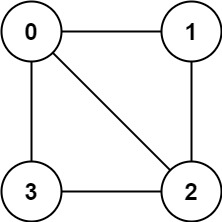
Input: graph = [[1,2,3],[0,2],[0,1,3],[0,2|1,2,3],[0,2],[0,1,3],[0,2]]
Output: false
Explanation: There is no way to partition the nodes into two independent sets such that every edge connects a node in one and a node in the other.
Example 2:

Input: graph = [[1,3],[0,2],[1,3],[0,2|1,3],[0,2],[1,3],[0,2]]
Output: true
Explanation: We can partition the nodes into two sets: {0, 2} and {1, 3}.
Constraints:
graph.length == n1 <= n <= 1000 <= graph[u].length < n0 <= graph[u][i] <= n - 1graph[u]does not containu.- All the values of
graph[u]are unique. - If
graph[u]containsv, thengraph[v]containsu.
Approach 1: Optimal
Intuition
- DFS
- Maintaining a color or type array
Algorithm
-
Create
nvariable for the length of the graph -
Declare & initialize
colorsarray for storing color for each node of lengthninitialized to0 -
Loop through the entire graph adjacency list
- if a node is not colored
- if dfs of the graph from that node is false
- return false
- if dfs of the graph from that node is false
- if a node is not colored
-
return true
-
DFS function
- Basecase
- if the node is already colored to the same color return true
- If the node is colored but not the same color return false
- Processing
- color the node with the color
- decide the next color
- Recurse case
- for all the neighbors of the node
- if dfs for the neighbor with the next color is false
- return false
- if dfs for the neighbor with the next color is false
- for all the neighbors of the node
- Backtracking
- return true
- Basecase
Code
class Solution {
public:
    bool dfs( int node, vector<vector<int>>& graph, vector<int>& colors, int color ) {
        if (colors[node] == color) return true;
        if (colors[node]) return false;
        colors[node] = color;

        int nextColor;

        if (color == 1) {
            nextColor = 2;
        } else {
            nextColor = 1;
        }

        for (int neighbor: graph[node]) {
            if (!dfs(neighbor, graph, colors, nextColor)) {
                return false;
            }
        }
        return true;
    }
    bool isBipartite(vector<vector<int>>& graph) {
        int n = graph.size();
        vector<int> colors(n, 0);

        for (int i = 0 ; i < n ; i++) {
            if (!colors[i]) {
                if(!dfs(i, graph, colors, 1)) {
                    return false;
                };
            }
        }

        return true;
    }
};
Complexity Analysis
- Time Complexity:
- Space Complexity:
- Where
- n -> node
- e -> edge
- Where