994. Rotting Oranges
Question
You are given an m x n grid where each cell can have one of three values:
0representing an empty cell,1representing a fresh orange, or2representing a rotten orange.
Every minute, any fresh orange that is 4-directionally adjacent to a rotten orange becomes rotten.
Return the minimum number of minutes that must elapse until no cell has a fresh orange. If this is impossible, return -1.
Example 1:
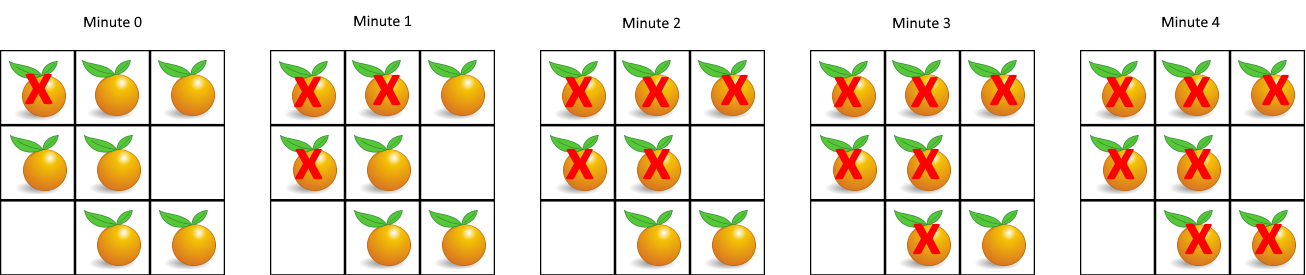
Input: grid = [[2,1,1],[1,1,0],[0,1,1|2,1,1],[1,1,0],[0,1,1]]
Output: 4
Example 2:
Input: grid = [[2,1,1],[0,1,1],[1,0,1|2,1,1],[0,1,1],[1,0,1]]
Output: -1
Explanation: The orange in the bottom left corner (row 2, column 0) is never rotten, because rotting only happens 4-directionally.
Example 3:
Input: grid = 0,2
Output: 0
Explanation: Since there are already no fresh oranges at minute 0, the answer is just 0.
Constraints:
m == grid.lengthn == grid[i].length1 <= m, n <= 10grid[i][j]is0,1, or2.
Approach 1: Optimal
Intuition
- Multisource BFS
- Directions array
Algorithm
- Declare and initialize variables integers
- rows
- cols
- time
- freshOranges
- Declare and intialize queue
queue<pair<pair<int,int>int>> qindicating{{row, col}, time} - Traverse through the grid:
- If cell is 1 then
freshOranges++ - If cell is 2 then push it to the queue with time as 0
- If cell is 1 then
- Declare & initialize a
directionsarray - BFS loop till the queue is not empty
- Get row, col & time in
r,c&tfrom q.front() - Pop the queue
- Update the
time = max(time, t) - Loop over the directions array
nr = r + direction.firstnc = c + direction.second- if nr & nc are within bounds and has 1
- We update the cell to 2
- Push the position in the queue
- Decrement freshOranges
- Get row, col & time in
- If freshOranges == 0, return time
- else return -1
Code
class Solution {
public:
    int orangesRotting(vector<vector<int>>& grid) {
        int rows = grid.size(), cols = grid[0].size();
        int freshOranges = 0, time = 0;

        queue<pair<pair<int, int>, int>> q;

        for (int i = 0 ; i < rows ; i++) {
            for (int j = 0 ; j < cols ; j++) {
                if (grid[i][j] == 1) {
                    freshOranges++;
                } else if (grid[i][j] == 2) {
                    q.push({{i, j}, 0});
                }
            }
        }

        vector<pair<int, int>> directions = {
            {-1, 0},
            {1, 0},
            {0, -1},
            {0, 1}
        };

        while (!q.empty()) {
            int r = q.front().first.first;
            int c = q.front().first.second;
            int t = q.front().second;
            q.pop();

            time = max(time, t);

            for (auto direction: directions) {
                int nr = r + direction.first;
                int nc = c + direction.second;

                if (nr >= 0 && nr < rows
                    && nc >= 0 && nc < cols
                    && grid[nr][nc] == 1) {
                        grid[nr][nc] = 2;
                        q.push({{nr, nc}, t+1});
                        freshOranges--;
                }
            }
        }

        return freshOranges ? -1 : time;
    }
};
Complexity Analysis
- Time Complexity:
- Space Complexity:
- n -> rows, m -> cols