Directed Graph Cycle GFG
Question
Given a Directed Graph with V vertices (Numbered from 0 to V-1) and E edges, check whether it contains any cycle or not.
The graph is represented as a 2D vector edges[][], where each entry edges[i] = [u, v] denotes an edge from verticex u to v.
Examples:
Input: V = 4, edges[][] = 0, 1], [0, 2], [1, 2], [2, 0], [2, 3

Output: true
Explanation: The diagram clearly shows a cycle 0 → 2 → 0
Input: V = 4, edges[][] = [[0, 1], [0, 2], [1, 2], [2, 3]
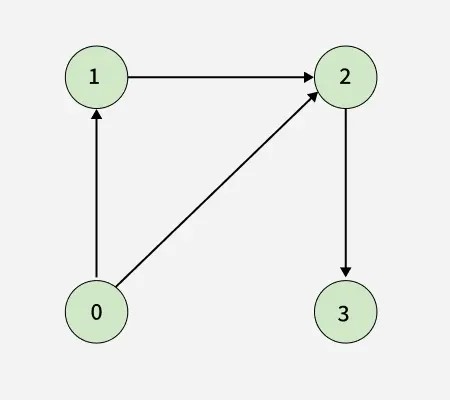
Output: false
Explanation: no cycle in the graph
Constraints:
1 ≤ V, E ≤ 105
Try more examples
Approach 1: DFS
Intuition
- DFS
- Visited array
- Path visited array to maintain the current path
Algorithm
- Coveted edge list to adjacency list
- Create
visitedarray &pathVisitedarray of length V. - For covering connected components loop through the visited array
- If not visited then
- Call dfs for the node
- If it returns true then return true.
- If not visited then
- return false;
- BFS
- Base case
- If node is visited & pathVisited then cycle exists return true
- If node is visited but not pathVisited then cycle doesn't exist return false
- Processing
- Mark visited & path visited
- Recurse case
- Call dfs for all the neighbors if true then return true
- Back tracking
- Reset pathVisited to 0
- return false;
- Base case
Code
class Solution {
public:
    vector<vector<int>> getAdj(int V, vector<vector<int>>& edges) {

        vector<vector<int>> adj(V, vector<int>() );

        for (auto edge: edges) {
            int startNode = edge[0];
            int endNode = edge[1];
            adj[startNode].push_back(endNode);
        }

        return adj;
    }

    bool dfs(int node, vector<vector<int>>& adj, vector<int>& visited, vector<int>& pathVisited) {
        // Base case
        if (visited[node] && pathVisited[node]) return true;
        if (visited[node] && !pathVisited[node]) return false;

        // Processing / Business logic
        visited[node] = 1;
        pathVisited[node] = 1;

        // Recurse case
        for (int neighbor : adj[node]) {
            if (dfs(neighbor, adj, visited, pathVisited)) return true;
        }

        // Backtracking
        pathVisited[node] = 0;
        return false;
    }

    bool isCyclic(int V, vector<vector<int>> &edges) {

        vector<vector<int>> adj = getAdj(V, edges);

        vector<int> visited(V, 0);
        vector<int> pathVisited(V, 0);

        for (int i = 0 ; i < V ; i++) {
            if (!visited[i]) {
                if (dfs(i, adj, visited, pathVisited)) return true;
            }
        }

        return false;
    }
};
Complexity Analysis
- Time Complexity:
- Space Complexity:
- Where,
- V = no. of nodes
- E = no. of edges
Approach 2: BFS (Topological sort - Kahn's Algorithm GFG)
Intuition
- BFS
- Topo sort is only applicable for DAG (Directed Acyclic Graph)
- If we are not able to generate a valid topo sort it means the we have a Cyclic graph
- We can use Kahn's algorithm to type to get the topo sort If the length is not equal to the total no. of nodes then the graph is cyclic
Algorithm
- Get adjacency list from edge list
- Declare & initialize
vector<int> indegreewith length of the nodes & zero - Update the indegree by looping through the adjacency list
- Declare a
queue<int> q - Loop through the
indegreearray- If the indegree of a node == 0 then push it into the queue
- Declare an
vector<int> ansarray - While q is not empty
- Get the node at the front of the queue & pop it
- Push the node into the q
- Loop over the neighbors of the node
- Decrement the indegree by 1
- If the indegree == 0 then push it into the queue
- if ans length is equal to total no. of nodes then return false
- else return true.
Code
class Solution {
public:
    vector<vector<int>> getAdj(int V, vector<vector<int>>& edges) {
        vector<vector<int>> adj(V);
        for (auto edge : edges) {
            adj[edge[0]].push_back(edge[1]);
        }
        return adj;
    }


    bool isCyclic(int V, vector<vector<int>> &edges) {
        vector<vector<int>> adj = getAdj(V, edges);

        vector<int> indegree (V, 0);

        for (int i = 0 ; i < V ; i++) {
            for (int neighbor: adj[i]) {
                indegree[neighbor]++;
            }
        }

        queue<int> q;

        for (int i = 0 ; i < V ; i++) {
            if (indegree[i] == 0) {
                q.push(i);
            }
        }

        vector<int> ans;

        while (!q.empty()) {
            int node = q.front();
            q.pop();
            ans.push_back(node);

            for (int neighbor: adj[node]) {
                indegree[neighbor]--;

                if (indegree[neighbor] == 0) {
                    q.push(neighbor);
                }
            }
        }

        if (ans.size() == V) return false;
        return true;
    }
};
Complexity Analysis
- Time Complexity:
- Space Complexity:
- Where,
- V = no. of nodes
- E = no. of edges